Knee Scooters vs. Crutches: Pros and Cons for Injury Rehabilitation

When facing a lower leg injury or preparing for foot or ankle surgery, it's crucial to consider the right mobility aid to help during the recovery process. From minor sprains to major surgical procedures, your mobility may be temporarily impaired, requiring the use of a supportive device. Two of the most common devices people turn to are knee scooters and crutches. But which one is right for you?
In this comprehensive guide, we will delve into a detailed comparison of these two mobility aids, helping you make an informed decision for your recovery journey. Our goal is to ease your mobility issues and help you regain independence during your healing period.
But before we dive into the details, let us introduce ourselves. We are EZ Walker Rollators, a leading provider of mobility aids. We've spent years helping individuals with mobility challenges find the perfect device to fit their unique needs. With our deep understanding of the industry and a wide range of products, we strive to help our clients navigate their recovery process with confidence and comfort.
Below we will provide an in-depth look at knee scooters and crutches, exploring their advantages, disadvantages, and most importantly, which situations they're best suited for. So, whether you're dealing with a long-term injury or a short-term setback, read on as we help you navigate the world of mobility aids, one step at a time.
Understanding Knee Scooters and Crutches
To make an informed decision about the best mobility aid for your needs, it's vital to fully understand what each option entails. Below we'll delve into the specifics of knee scooters and crutches, helping you grasp their unique features and functionality.
Knee Scooters: An Innovative Solution
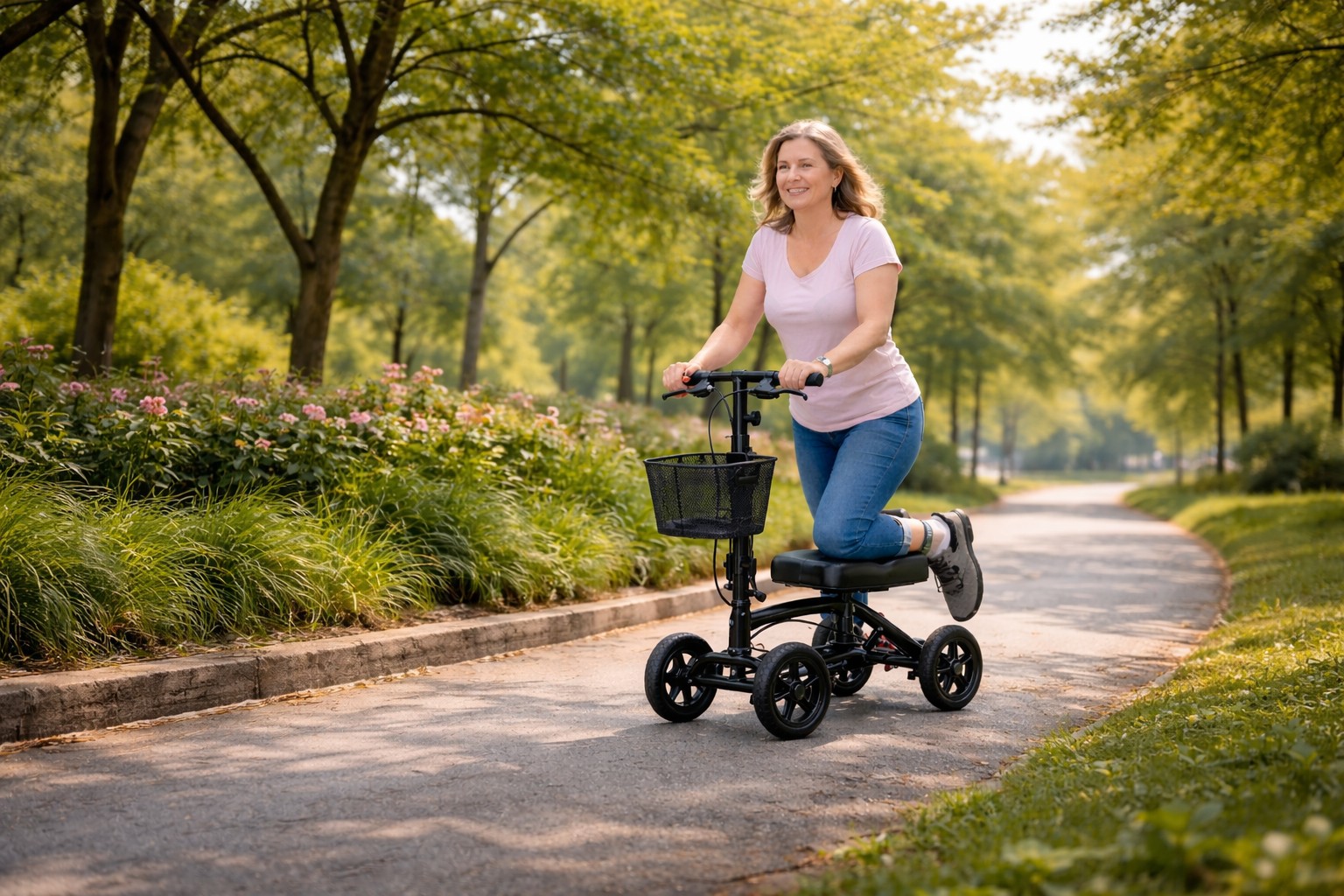
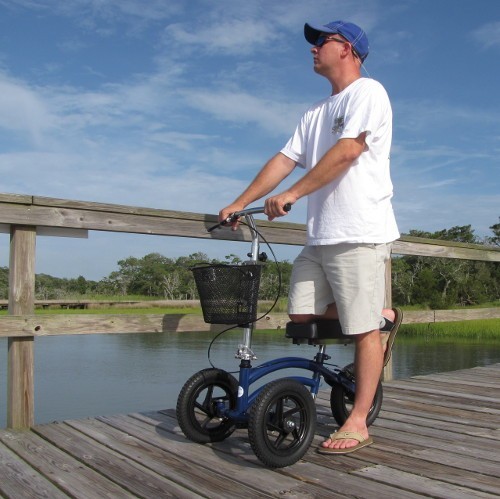
A knee scooter, also known as a knee walker, is a non-weight bearing device that has been growing in popularity due to its unique features and benefits. The design is relatively simple: a padded comfortable knee platform for your injured leg, an adjustable handlebar for steering, and wheels for easy transport. Some models even feature a front axle that enhances maneuverability. You rest your injured leg on the padded knee pad, using your good leg to propel yourself forward.
One of the most significant benefits of a steerable knee scooter is its ability to navigate narrow hallways and tight spaces. Its compact and agile nature allows for effortless maneuvering, an essential feature for those living in smaller homes or navigating busy offices.
Knee scooters are also optimal for mobility due to their braking system. These brakes allow you to slow down from high speeds allowing for more flexibility for mobility and making recovery much more fun. They are designed for consistent braking and high pressure so there is no need to worry about brake failure as long as you are purchasing from a respective company.
Weight capacity can vary for a steerable knee scooter walker but typical ranges support up to 300lbs. However, some may include more or less so it is important to ask before selecting one. Our experts at EZ Walker can help answer all your questions or check out our product selection for specific details for each product. EZ Walker's wide selection of knee scooters for purchase or rentals ensures that anyone recovering from a knee, ankle, or foot surgery can recover easily and conveniently by directly shipping the scooter to you.
Crutches: A Time-Tested Aid
On the other hand, crutches have been a time-tested solution for temporary impairment due to lower leg injuries. There are different types of crutches, but for this discussion, we'll focus on standard crutches and the hands-free single crutch.
Standard crutches are perhaps what most people envision when they think of a mobility aid. They consist of a top pad that fits under the arm and a handle for the user to grip, providing support while you navigate on one leg. They require decent upper body strength and coordination, but once mastered, they can offer reliable support and mobility.
The hands-free single crutch, a more modern variant, straps directly onto the lower leg, freeing both hands and requiring less upper body strength. It offers a balance of mobility and freedom that many users appreciate.
Crutches have a few unique advantages over knee scooters. For example, they allow users to tackle stairs, a task that can be challenging with a scooter. Plus, they are generally lighter and easier to transport, and less affected by weather conditions, making them a versatile mobility aid for various scenarios.
In the next section, we will dive into a more detailed comparison, discussing the pros and cons of each mobility device. This deeper analysis will help you understand which device – the knee scooter or the crutch – will best support your specific needs and lifestyle during your recovery process.
Pros and Cons of Knee Scooters
Understanding the advantages and disadvantages of using a knee scooter can help you determine whether a knee scooter is the right fit for your unique circumstances and mobility needs.
Benefits of Knee Scooters
One of the key benefits of knee scooters is their ease of maneuverability. Their design allows for sharp turns and easy navigation through tight spaces and narrow hallways, which can be a challenge with traditional crutches.
Knee scooters are also great for outdoor use. Whether you're traversing a paved park pathway or navigating the corridors of a shopping mall, the smooth-rolling wheels of a knee scooter make it a superior choice for many outdoor scenarios.
Another significant advantage of knee scooters is their overall comfort. With a padded platform for your injured leg, and the weight distributed more evenly than when using crutches, many users find knee scooters to offer a more comfortable mobility solution. The knee pad alleviates pressure on the injured leg, and the scooter design requires less upper body strength, reducing the strain on your arms and hands.
Limitations of Knee Scooters
While knee scooters offer many advantages, they are not without their drawbacks. One downside is the potential for muscle atrophy with long-term use. As your injured leg is not in use while operating a knee scooter, over time, this can lead to some muscle loss. To mitigate this, regular exercise and physiotherapy are often recommended.
Knee scooters may also be less effective in certain environments. For instance, navigating stairs or uneven terrain can be a challenge. Therefore, if your daily routine involves a lot of stair climbing, a knee scooter may not be the best option for you.
Finally, despite their ease of use, knee scooters do require some balance and coordination to operate safely. Thus, they may not be suitable for individuals with significant balance issues or those recovering from more severe injuries.
At EZ Walker Rollators, we recognize these limitations and have carefully selected a range of knee scooters that work to mitigate them. From models with larger wheels for better outdoor use to those with enhanced features for improved comfort, we strive to ensure our products meet the diverse needs of our customers.
Pros and Cons of Crutches
Now that we've examined knee scooters in detail, let's turn our attention to crutches, a more traditional but still highly effective mobility aid. Understanding the pros and cons of crutches will equip you with the knowledge needed to make the best decision for your situation and lifestyle.
Benefits of Crutches
Versatility is one of the top advantages of crutches. Unlike knee scooters, crutches are suitable for various scenarios, including traversing stairs, sloping surfaces, or uneven terrain. Their simple yet effective design makes them a good option for both indoor and outdoor use.
Another significant benefit of crutches is their lightweight nature. This makes them easier to transport than most knee scooters, a factor that may be particularly important if you're frequently on the move.
Crutches also promote upper body strength. While this may be challenging at first, consistent use of crutches can build your arm, shoulder, and core strength. This can be beneficial, especially if you're recovering from a long-term injury that requires a period of physical rehabilitation.
Lastly, the hands-free single crutch can offer a balance of mobility and freedom. This more modern variant frees both hands and requires less upper body strength, which many users find advantageous.
Limitations of Crutches
However, crutches do have their limitations. Upper body strength and coordination are necessary to use them effectively. Individuals with limited arm strength or balance issues might find them challenging to use.
Another limitation is comfort. Crutches place a lot of pressure on the underarms, hands, and wrists, which can lead to discomfort with prolonged use. In comparison, knee scooters distribute weight more evenly, potentially offering a more comfortable experience.
Lastly, traditional crutches do not offer a hands-free experience. This means carrying items can be more difficult when using crutches.
In the next section, we will conclude our comparison and provide some additional guidance to help you make an informed choice between a knee scooter and crutches.
Making the Right Choice: Knee Scooter or Crutches?
After exploring the unique features, benefits, and limitations of both knee scooters and crutches, it's time to decide on the best option for you. But remember, the best choice depends on your specific needs, lifestyle, and the nature of your injury. To simplify your decision-making process, we've prepared a summary of key considerations:
- Mobility & Lifestyle: If you frequently navigate narrow hallways, tight spaces, or are constantly on the go at work or home, a knee scooter might be the best choice due to its maneuverability. Conversely, if your routine involves climbing stairs or traveling on uneven terrain, crutches might be more suitable.
- Physical Strength & Balance: Crutches require decent upper body strength and good coordination. If you're up for the challenge and want to build upper body strength during your recovery, crutches could be an excellent option. However, if maintaining balance is a concern, or if you lack upper body strength, a knee scooter might be a more suitable choice.
- Comfort: Knee scooters are often praised for their comfort, especially for long-term use. The padded knee rest reduces discomfort, making it an excellent choice for those prioritizing comfort. Crutches, while they may be less comfortable, are generally lightweight and easier to transport.
- Nature of Injury: The type and location of your injury can also play a big role in deciding which mobility aid is best. For instance, if you're dealing with a temporary impairment like a broken foot, ankle surgery, or a knee injury, a knee scooter could be an optimal solution. For more severe or long-term injuries affecting overall mobility, crutches or even a wheelchair may be necessary.
At EZ Walker Rollators, we're passionate about helping you regain your mobility with the best-suited device. We offer a range of knee scooters, crutches, and other mobility aids tailored to different needs and lifestyles. Our expert team is always ready to guide you through the selection process, ensuring you choose the best mobility aid for your unique circumstances.
Remember, selecting a mobility aid is an important step in your recovery journey. Your choice should help maintain your independence, improve your mobility, and support your overall comfort and well-being. Whether you choose a knee scooter or crutches, we're here to ensure that you're on the road to a swift and smooth recovery.
Thank you for choosing EZ Walker Rollators as your trusted partner in your recovery journey. Your mobility, comfort, and independence are our top priorities. Feel free to reach out to us anytime if you need further guidance or assistance – we're here to help you every step of the way.